
- Home
- Varna, Caste / Jati & Untouchability
Varna, Caste / Jati & Untouchability
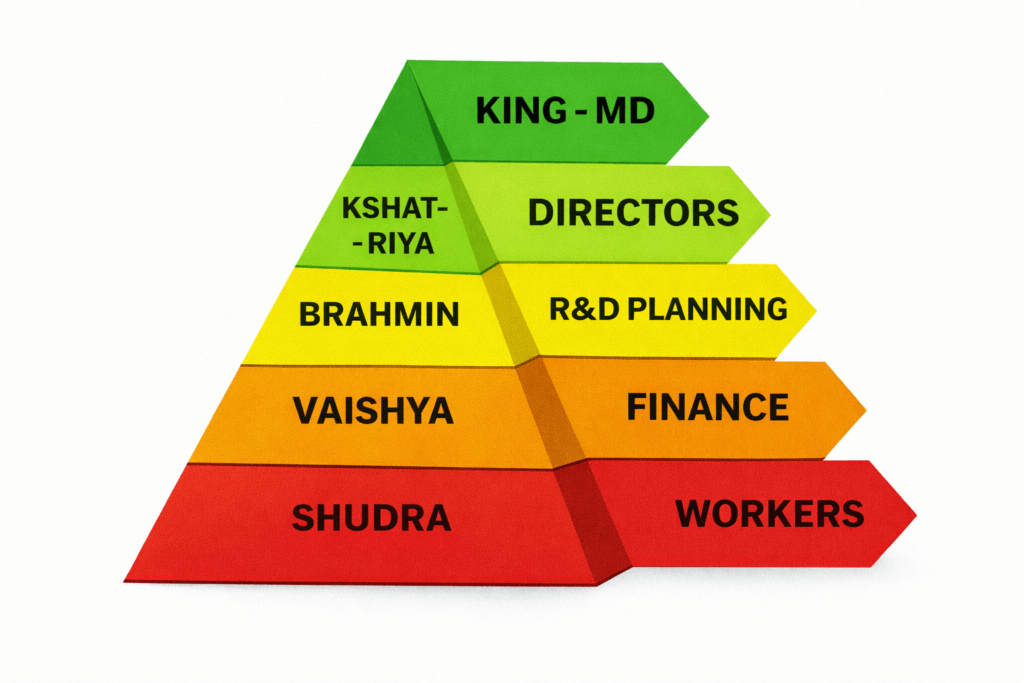
First – The Brahmins.the Learned Class
Those who helped expanded your consciousness (Brah) and your mind (Manas).
They were called upon to keep alive the store of knowledge and even add to it by continuing to learn. They were then expected to use such knowledge to responsibly guide the others in the Society to live securely and happily and contribute to the Society as required. They also, guided the building of temples and involved all in the community to learn about the Culture and Dharma and thus also, made everyone feel part of the Community.
They were also; many times, tasked to locate suitable places to set-up new villages to expand the kingdom into unsettled places.
Their learning made them able to do so, being guides, advisors and teachers, from the Rajas to the poorest of the members of the Society, and as priests in the temples.
However, as their learning could give them the power to easily manipulate the illiterate and even the lesser literate others, their power needed to be constrained, so as to prevent misuse and in fact to be allowed to actually encourage its proper use for the benefit of the Society.
For this reason, all Brahmins were prohibited from owning lands or cattle or getting involved in any business. Their sustenance could only come from the donations (daan) made to them by those they advised and guided and prayed for. The Brahmins had stature and respect in the Society but they were always seen as poor people deserving of ‘daan’ and also, all the immovable assets that they may receive was only for the life time of the recipient and the assets thereafter reverted to the Raja.
However, ancient records show that the Brahmins only managed the wealth of the Temples, received as donations to the Temple from all citizens, mostly the middle classes, under the supervision of the King and representatives of the Community. The Temple funds were also, used to support trading and entrepreneurial ventures of the local/ community ‘Shrenis’/ Guilds and also the artisans/ craftsmen, from which the Temple and its Priests received additional ‘Daan’ and status. The Temple funds were also, used for education and skill development and for encouraging trade and entrepreneurship and also, to support the citizenry in times of distress or disaster. Temples also ran ‘Annadana’(food donation) for all. As do Gurudwaras run Langar’s today.
If the advice they gave was not in the interest of their patrons, they obviously would not receive adequate donation and the earlier gifts may then even be taken away. It was therefore in their interest to ensure their learning was always used to advise their patron for the patron’s benefit, and through them the Society’s benefit.
Of course, the status they enjoyed and the benefits or donations they received depended on the value of their advice to the concerned recipient of the advice and also, on the status of the recipient. A Raja’s advisor would be the Raj Purohit or Guru and so on down the line.
The custom of challenges of knowledge and learning and demonstrating the same in displays and debates, such as ‘Avadhanams’ / Challenges, ensured that merit was recognized and at each higher level the best were appointed. The defeated was replaced by the more meritorious.
The Brahmin Varna, for its own collective welfare, would remove any of them who did not maintain the Dharma as required when giving advice. If the advice to their patron at the respective level was selfish and resulted in dissatisfaction of others, then those others would obviously not be able to donate adequately to their advisors who, for their own interest, would then take up the complaint with the advisors of that upper level.
Dealing with the common citizen, the Brahmin saw himself as not dependent on them as much as they were dependent on him to direct their lives and hence, saw himself as superior. However, he understood this mutual dependence and also, understood that here too he needed to be seen as one who had no personal interests of his own which may come in the way of his being a trusted advisor even as he was actually dependent for his own survival on their largesse or contributions. He therefore sought to cloak such contributions as being part of the rituals and ensured his own benefit by including other Brahmins in such rituals as those who need to be also contributed too, both for recognition from his peers, these other Brahmins, but also, as a measure to ensure a safety net for his own family.
Hence, the concept of a Brahmin as one who is rich in learning and knowledge of the esoteric wisdom of dealing with the Gods and the wisdom derived from others experiences, while still being poor when it comes to material wealth and hence, dependent on the goodwill and gratitude of the people he guides.
There is a great responsibility in taking up learning and being willing to be an advisor. Not everyone is willing to take up such responsibility and its attendant constant effort, challenge and restrictions. Also, not all those who are willing are capable. But those that do so successfully, to the satisfaction of those they advise, are rightly looked up to.