
- Home
- Varna, Caste / Jati & Untouchability
Varna, Caste / Jati & Untouchability
The British found the social structure of the Varna system, with the Brahmins as the guides and teachers, the mainstay of the system and the local temples as the source of guidance, learning and commerce and community harmony and togetherness, which came in the way of religious conversions and acceptance of the British as their new benefactors. Hence, their determination to belittle the Brahmins and destroy their societal standing by falsely running down the temple culture by highlighting them as dens of inequity and finally also, destroy the cultural and economic backbone of the Dharmic
Society by banning Sanskrit and the old Gurukul schooling system. This allowed them to encourage the so-called lower castes to see themselves as discriminated against and accept the British as the real allegedly superior Aryan race bringing them emancipation and thus allowing for the conversion of at least those who they termed as the lower castes/dalits/tribals to Christianity.
Today, efforts are being made to even equate some elements of what they claim exist in the Caste system with slavery. A very pernicious and mistaken argument, which must be countered by a proper understanding of what the ancient system really was and why it was implemented in the context of those times.
For properly understanding the Varna classification we need to keep in mind the context in which it was made.
- The average life span in those times was around 30 years and the maximum was generally about twice that, i.e. 60 years. Of course, for those who managed to live beyond 15 years, the life span would increase by another 5 to 10 years up to 35 to 40 years. Such an increase was also, there for those who crossed 30 or 40 but they would be far fewer and the distribution curve would end with a long tail of a few even longer-lived persons. For most of the people, 30 to 40 was the general age and around 60 was the upper limit. This is well proven by the fact that attaining to ‘Shashtipurthi’ was seen as the end of the working life and anyone who lived longer was encouraged to take Sanyas or go on Pilgrimages, which in those days were long, arduous and dangerous enough to soon lead to death. Of course, such pilgrimages also, served to strengthen the bonds of peoples all across the Country. Spoken Sanskrit, though written in the different scripts of many of India’s phonetic languages, was understood by all and the young priests who accompanied such pilgrims, being proficient in Sanskrit were able to communicate with other priests and Sanskrit speakers across the Country.
The Hindu calendars, which restarts again at the end of every 60 years, also, emphasizes the above. Do imagine compressing all that one seeks to do in one’s life into about 30 years or at most into about 40 years. Growing up, learning a skill to earn a living, getting married, having children and teaching them skills to live on, getting them married and settled and perhaps living long enough to see the grand children grow and be able to advise them about life. The context people lived in such times (up to say 1850 CE in India) was indeed different from the circumstances we live in now and we thus need to let our imagination guide our understanding.
- Actually, the Varna classification should have more correctly been seen as a division of ‘Classes’ each with specific responsibility for the proper working of the Society.
Everyone started as a Shudra, however, the Society, as it grew, would have needed to become organized into various classes to undertake specific responsibilities to enable it to function optimally and also, protect itself and grow further, even as it interacted with other Societies across the Country.
In such circumstances the Varna classification was developed in Ancient India with clear responsibilities, for each class, and limitations guided by Dharma, that would prevent any of them from misusing their position and thus endangering the very fabric of the Society.
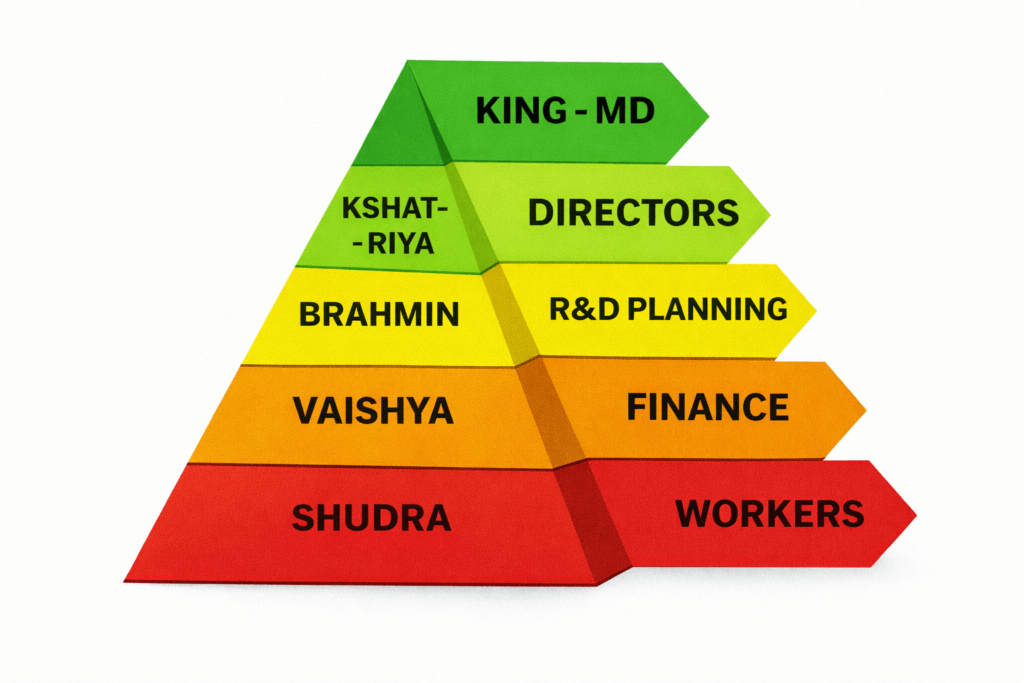
A simple comparison with any modern organization / business shows the necessity of various departments or functions. Planning and Technology (Brahmins) – Management, Operations, Administration, and Security (Kshatriyas), Finance and Marketing (Vaishyas) and finally all the others as only workers (Shudras).
Till a few centuries ago, there was no barrier for anyone, especially in the more relatively urbanized areas, from taking up work in that Varna in which their skills were valued, this was more practical if the person moved away from his birth place into regions where only his skill or knowledge was the criterion.
- Most of the population of those times, though literate to the extent of being able to work in their fields of work, especially in the local language, were not really learned as the process of learning is a long process and has to start at an early age, more so in the earlier ages in history when learning was oral and memory based. Hence, those seeking to learn more comprehensively had necessarily to be supported by the others, who would in turn seek to benefit from the advice and teachings of the learned, in their labour/work, social life and even political and military matters.
In those days, just surviving would on most days require hard work, from the ‘Can See’ time of dawn to the ‘Can’t See’ time of dusk, leaving little time for learning other than what was essential, if at all. History has often showed us that if learning was not continuous and was not properly supported, it is forgotten within a few generations and civilizations soon regress into tribalism or barbarism.
For this reason, the really learned could only be a small percentage of the population and competition was pretty fierce for the top posts held by the really learned persons. However, learning was not limited to only one class or group. Merit and skills counted and those who sought to learn could often manage do so. This is evidenced by the fact that our epics Ramayana and Mahabharata and many other such ancient writings were written by non-Brahmins; even Manu the author of Manu smriti was a non-Brahmin. Obviously, they had learnt Sanskrit and were respected.
Now let us consider each of the Varna’s, what they were deemed responsible for and how their powers were limited or controlled