
- Home
- Varna, Caste / Jati & Untouchability
Varna, Caste / Jati & Untouchability
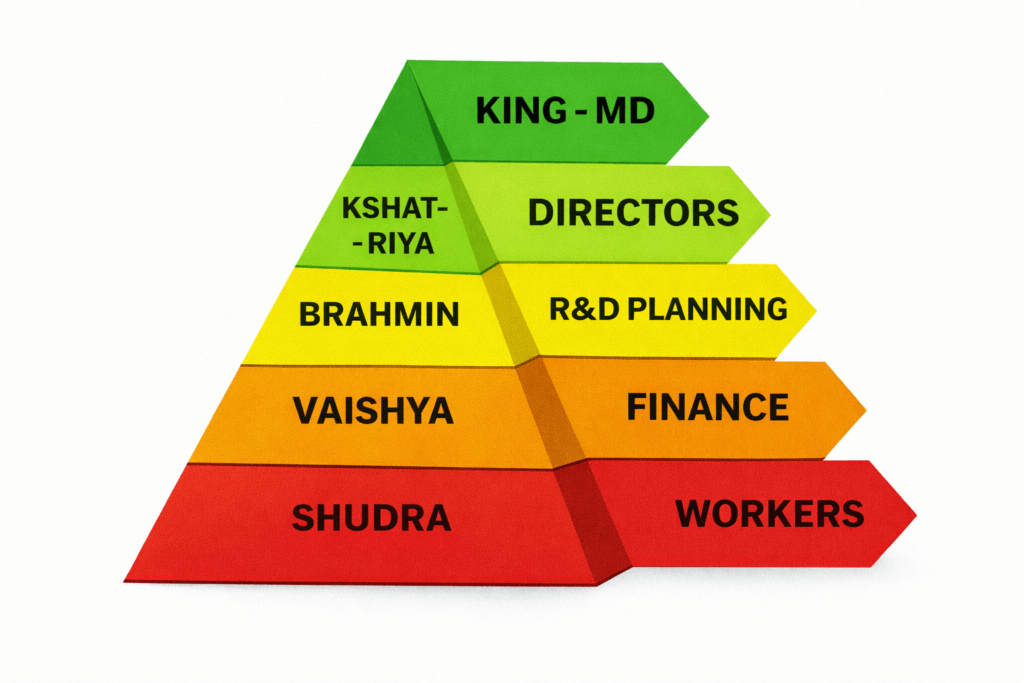
The Varna System
There are only four Varnas but many thousands of Jatis. The Bhagavad Gita describes the 4-Varnas not as lineages but as Categories or Classes that are needed to run a Society, just as any large organization today has different departments. These essential classes they designated as Brahmin, Kshatriya, Vaishya and all the others as Shudra, according to the Gunas or characteristics or qualities born of their own nature and the profession they followed. Varnashrama dharma was a Socio-economic classification based on work to be done by people in a Society, based on their aptitudes, skills, ability and age and was flexible for the orderly and prosperous functioning of the Society and the general happiness of all the people therein. People could change their Varna by proving their learning, their mettle in battle, their skill in trading or in crafts.
People in any Varna could in principle take up any profession. Any one of any birth could perform even the priestly functions as long as he was deemed virtuous, learned and wise.
The Varna system evidently worked well, as otherwise it would not have lasted so many centuries, even millennia.
If the Varna system was stratified and treated the people badly as the British and their many followers would like us to believe even today, it would have been so described by the many historic visitors to India who recorded their views so differently, so positively and with great admiration for the orderly and prosperous functioning of the Society and the general happiness of all the people Ancient. Buddhists describe the Varna system as non-rigid, flexible, and devoid of features of a fixed social stratification system.
Megasthenes – Ambassador from the Greek Seleucus to the Court of Chandra Gupta Maurya for over five years. His writings INDIKA were quoted by many others.
Fa Hien was another Chinese pilgrim who visited India around 399 CE covering from Peshawar to Bengal over about 15 years.
Huen Tsang from China came to India in emperor Harshavardhana’s time in 629 CE, spent 14 years travelling all across India both North and South and also, 8 years studying in the University of Nalanda.
All admired the Indian Societal system and wrote about the great prosperity of the Society then and the lack of beggars. Even Lord Thomas Babington Macaulay remarked on this. Obviously, poverty was the effect of the subsequent actions of the colonizers as they looted India.
Prosperity in any nation or Kingdom would reflect the prosperity of the middle class. In India, the middle class consisted of the working majority in Agriculture, Animal husbandry, and especially as Artisans, weavers and craftsmen whose products were greatly coveted across the world. It was this wealth that in later centuries attracted, initially the Islamic invader and later the western colonists especially the British, to come and loot. It was their depredations that drove India into poverty and not the Varna system.
The administrative system of those days was also, seen by these ancient visitors as just and admirable.
The Mantri Parishad, or Council of Ministers, advised the King and administered the Country. The King was Supreme but was seen as the Guardian of Dharma and the Raj Purohit and the Council of Ministers were also, bound by the laws of Dharma.
The Members of the Mantri Parishad had to qualify themselves and show their ability by passing tests of dharma, ethics and of their attitude to, love, fear and money. They were aided by a well-organized hierarchy of bureaucracy selected on merit.
The Ministers were chosen from all Varnas or Classes of the Society. The Mahabharata records Vidhura, a Shudra, as the Prime Minister.
The entire land was the property of the King and no private person owned any land of their own, except perhaps temporarily, as a grant from the King. Generally people worked on land by sharing the produce thereof with the King.
Varna is erroneously translated as colour but was actually as a designation of Social status, not by birth alone but by ‘Guna’ and ability/occupation. It was aslo quite inter-changable as desired and worked for.
In fact, as time passed, the occupational classes in India got divided into sub-classes or jati’s that offered a sort of social security system to its members and hence, resisted social interaction, marriages out of jati etc. Jati is regarded as horizontal unity cutting across several villages, while the village itself is a vertical unity of Varna and Jati.
Over time, what started as an open structural category or group became a closed group and soon thereafter became frozen into a Jati by vocation and even by birth, caused by increase in population, religiosity. Foreign domination and terminology led to such Jati’s being identified as castes.
The community and cultural life of the villages centred on the temples where Dharmic values were expounded in tales of historic heroes and even enacted through folk dramas to imbibe them in the people and where educational classes were also, conducted in which, as historic records show, over 60 percent of the students were Shudras and many even girls. Most people of those days were literate, especially in the local language, as was required for undertaking their professions, but only a few were really learned.
Those who fell out of the system were ostracized and as out castes were deemed untouchables. The Barbarians, the unrighteous and the unethical people were also, considered as out castes.
Some others, though part of the Society, were treated as untouchables for practical reasons as explained below. People lost their untouchable status when they joined their fellow citizens fighting in the King’s armies against others and also by learning other skills and moving into other places.
However, the British, European and other invaders who ruled in India saw the Societal Class or Varna system, difficult to grasp, they not only viewed it as an obstruction to religious conversion, especially to Christianity, and hence, declared it a Devil’s invention, but also, to the claims they made of racial, moral, cultural and historical superiority to gain acceptance for their rule over Indians, and because their arrogance and their belief in their, Biblical gospel, could not allow them to accept the ancientness and superiority of Indian Culture and Philosophy.
‘Caste’ is not a word in any an Indian language; hence the very concept of ‘Caste’ is foreign to India. The word Caste was brought into India by the Portuguese for whom ‘Casta’ denoted a right by birth. Not really understanding the Varnashrama and Jati system, they and the British, mapped their concept of Casta as Caste, as an overall umbrella onto this system and used their interpretation of it to denigrate and destroy the Indian Varna system. Caste as is generally understood today is seen to include Varna and Jati and the resultant confusion has led to much misunderstanding which was encouraged by the British. These invaders were determined to equate the Varna classification with what they saw as the Caste system as based on birth and not occupation, and denigrate the same for the reasons given above.
The only ‘by birth’ classification in the Indian social system was, and still is, the ‘GOTHRA’ denomination, which starting with that of the Seven ancient Sages, thereafter multiplied into 108 and perhaps, by today into a few more. The British did not bother about ‘Gothra’ as it had no relevance to their purposes. Gothra is an exogamous classification that cuts across Jati and even Varna. It does not allow for marriage within the same Gothra. That makes it an inclusive classification, compelling marriages with only those from another Gothra. The Gothra is meaningful even today, and will continue to be so until the science of Genetics presents us with a better alternative.
The word Dravidian is also, not an Indian word, again it was introduced by the British and built up on the words ‘Dra’ and ‘Vid’ introduced by Adi Shankara to indicate that southernmost land point that was washed by the three seas. They invented the Aryan invasion theory to denigrate the original inhabitants of India as people conquered and driven into Southern India by the superior Aryans, who they said brought Vedic culture and philosophy into India and were now North Indians. (See India- Prehistory).
The word Dalit also, was first introduced by the British in the 19th century to group together as many of the lower Jatis’ (Non-Agricultural manual labourers and even artisans) so as to divide the Society and make it even easier to convert them by inducing them with English education and job opportunities and offering them greater recognition than given to the Brahmin’s. Jati was described as bad and shown as a rigid caste system during the British colonial era and the differences were highlighted. So was the word ‘Tribe’ also introduced by the British to differentiate the forest dwellers from the settled societal Jatis.