
- Home
- Varna, Caste / Jati & Untouchability
Varna, Caste / Jati & Untouchability
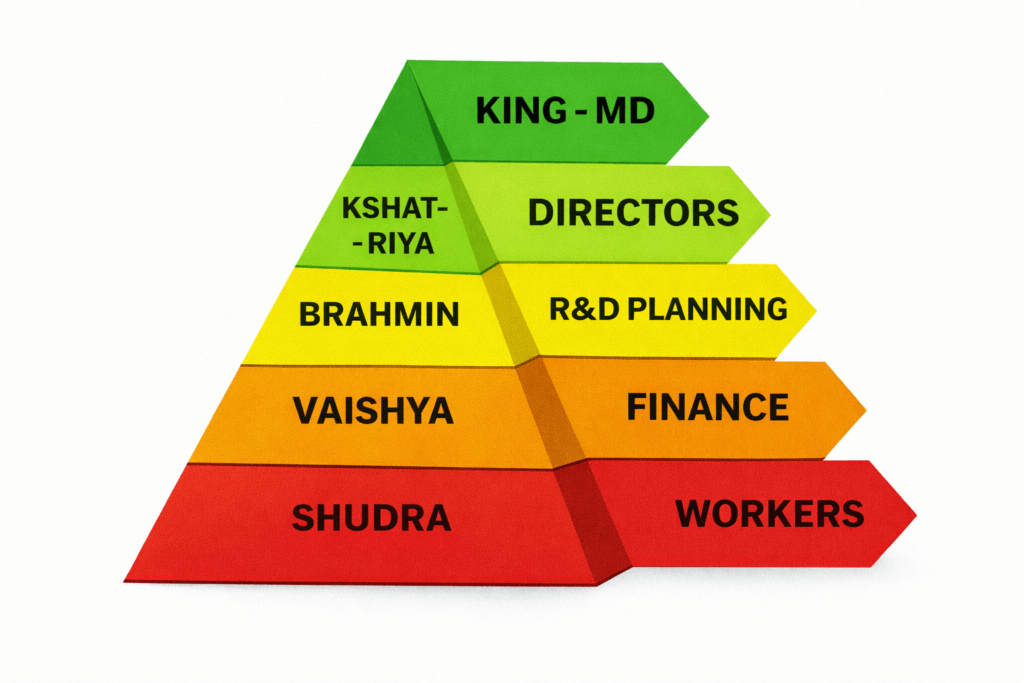
The ancients understood ecology. They knew they had a nice safe niche in the scheme of things and that it is more sensible for each to depend on those who specialize in certain activities as service providers or manufacturers and for each to themselves strive to provide that which the others need, even if it is the more immeasurable but essential things like security, administration, justice, knowledge, care of the commons and of charity as a sort of safety net of the last resort.
The philosophy of each would be “Don’t rock the boat”. Each does what is to be done by them in the allocated sphere as long as this does not endanger them.
Why didn’t any of them try to change things, take up other options? Such effort would cause upset of the system and require everyone to keep a constant watch on everyone else, something that is not at all in the interest of the general public or even of their own community. Hence, even one’s own caste / jati group would discourage such an attempt by anyone within them unless they can see a way for all to gain, in the long term, without risk to themselves as a group. Like an opportunity to set up their own kingdom due to conquest of new territory or out of other kingdoms shattered by war or natural disasters.
Each caste/ jati gained its strength from more and more specialization of the services they provided to the rest of the community and would strongly, even violently resist any encroachers or competitors. Even other castes/jatis would help resist such efforts ‘to rock the boat’. A renegade could survive or be allowed to escape as long as he keeps away as an exile and did not attempt to become a part of the orderly world again.
The British sought to break our societal structure, loot the wealth, take away the technologies and drive people into poverty. They destroyed the Artisan classes, especially the weavers to destroy all competition and yet some-how convinced the lower and by then mostly illiterate ranks in the Societal structure that they were all being suppressed and taken advantage of, by the Brahmins, who therefore were the villains responsible for all their difficulties and cause of all their unhappiness and that it was only the British who would provide them a better life, if they converted and/or accepted them as superior.
They introduced and enforced the ‘Doctrine of Lapse’ to take over prosperous Kingdoms, or supported treachery in the Royal families and thus setup puppet rulers beholden to them. Finally, they instituted the Zamindari system, appointing the local goons as Zamindars (land lords with the right to collect/ extract what taxes they could, pay a fixed sum to the British and keep the rest for themselves.). The taxes were soon raised to levels of about 60 percent destroying the middle classes, the Artisans and Agriculturists, and driving them all into such abject poverty as to compel many of them into becoming indentured labour in other British colonies. Recent British researchers have estimated that the British had looted over 45 trillion Pounds from India from, the mid-18th century in addition to the many more trillions looted by the East India Company ‘Nabobs’’ in the earlier centuries.
Ofcourse, the earlier Islamic Invaders had also, looted India. The Mughals not only supported every Muslim supplicant who came to India with generous grants and subsidies but also, supported all the Mosques and regimes in the Middle-East, especially Mecca. It is worth noting that the till then, largest Irrigation Project in the world in the Tigris-Euphrates River basins was entirely funded by the then Mughal Ruler from India even as not a single irrigation Project was taken up here. The so-called Mughals were actually Turkic people from Central-Asia, and were foreigners in India. They did not allow the local converted Muslims to become rich. They were all restricted to the trade and artisan classes to which they belonged, as these were required by the Rulers. Hence, even after 800 years of Muslim rule such converts and their following generations, continued to be relatively poor and uneducated.
Since Biblical scholars declared that the Genesis of Creation was 4004 BC, the British and other Westerns strived to ensure that there could be no history prior to that, and to designate all claims of any such earlier civilization as only myths, not history, and thus not to be believed in. To ensure this, the British also, banned all Sanskrit learning and all local language schools thus denying the locals the knowledge of their own History. Instead, the British encouraged only the learning of English and of History as they wanted them to see it. They also, ensured that the local temples were no longer operational as centres of culture and community, and all the temple properties and monies were taken over by the Governments.
These steps were enough to destroy the cohesiveness of our ancient well functioning Societies, to ensure that we soon forget our history and heritage, and to see the British / Europeans as the harbingers of development and civilization even as they were actually trying to appropriate our philosophy and ancient knowledge, seeking to represent it to us as actually being theirs. Creating a dependence on themselves allowed the British to take up conversion of those who they sought to show as disadvantaged and lower castes, to Christianity in a big way. Also, playing one group against the other in Society
helped them to take the help of one group to rule the other.
As the old saying goes – “Until the Lion learns to write and tell his side of the story, the tale of the hunt will always glorify the Hunter.”
The silver lining to this dark cloud in our history, is perhaps that we soon learnt from them of their history, their use of technologies and their philosophy, and are now in a position to recognize their objectives, to understand their misdoings and correct them all within our present Society, perhaps in a better way, as the new technologies of the 21st century brings greater prosperity, even abundance, to all of us.