
- Home
- Interse Currency Valuation & Monetizing Personal & Temple Gold & Silver Holdings
Interse Currency Valuation & Monetizing Personal & Temple Gold & Silver Holdings
Quotations for consideration
“A weak currency is the sign of a weak economy, and a weak economy leads to a weak Nation.” – Ross Perot
Background
The past 500 or so years have witnessed some countries of the western world use the knowledge and technology, taken from India and adapt it to develop militarily in their fights and fight amongst themselves, seeking local, and thereafter global domination at the expense of others. (See – ‘Global Domination using Money, Trade & Climate Change’).
The Dutch were the first to introduce Capitalism, to incorporate companies owned by shareholders, perhaps influenced by the functioning of the Shrenis/ Guilds they saw in ancient India, and expand their trading, followed by the British and then the USA. Such domination led to the currency of each being the most acceptable or as the reserve currency for the world, during the period of their dominance. Such periods lasted only between 100 to 250 years for each, even as each in their prime, strived to extend their sway by finding ways to continue their sway seeking to continue the general acceptance of their currency as the reserve currency, by manipulation of economic markets and instigating or even initiating wars, both military and economic, leading to one – sided trading transactions and even currency debasement and devaluation. (See –‘Currency Wars on www.ideaz4india.in).
It is interesting to note that the Dutch East India Company, then the most powerful European trading and military force in India and the East Indies at the height of the Dutch power in the maritime world, was decisively defeated at sea and on land, by the forces of Raja Marthanda Varma of Travancore, a small kingdom in South-West India, during the Travancore -Dutch war, in the battle of Colachel on 10th. August 1741, and the Dutch Commander captured. This, the first defeat of a European Power by any Asian Power, not only led to the collapse of the Dutch East India Company in India, but also to the decline of the Dutch maritime power across the world, and the rise of the British. This raises a question, – what would have History been like if the other Indian Rajas had recognized the threat, then and had
also fought against the creeping invasions of other European powers, the British, the Portuguese, and the French, instead of allowing themselves to be played by these colonial powers into being divided and fighting against each other.
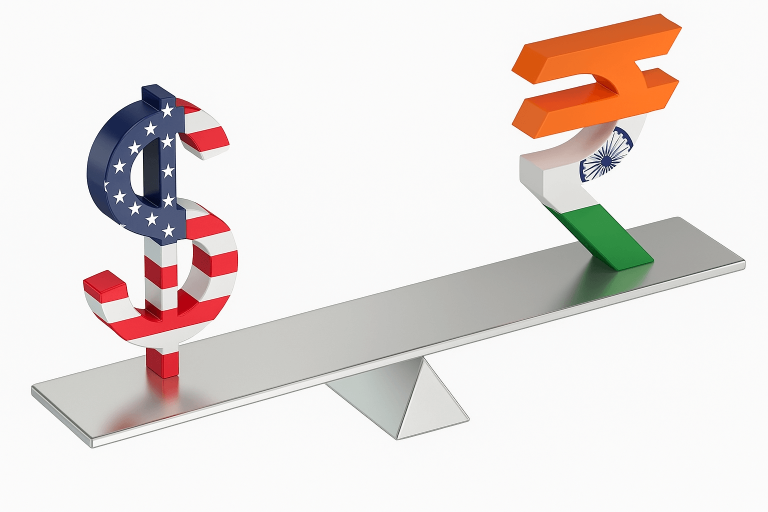
However, history witnesses that the resulting imbalances and unrest raise demands for settlements and alternate solutions soon leading to the final collapse in the value of that currency, and its replacement by what is perceived as a more stable and equitable alternative. Today, it is the US $ that stands as the world’s reserve currency, as the USA has ensured that it is the only acceptable currency that the world can buy Oil with. However, recent financial and geo-political trends are questioning such dominance of the US$.
Also, the difference between the debt in US $ of other countries and that of the USA itself needs to be understood. The other countries need to earn US $, by exporting cheaply to the USA what it needs, to repay their debts, while the USA never has to repay its own debt, as it is in its own currency which it can easily print for itself as much as it needs. However today, the USA has greatly devalued its currency and is struggling to divert its citizens attention from this by instigating conflicts all over the world. China’s military strength, and its economic strength even as it too is facing economic problems, makes it an effective prospective competitor to the USA, especially as it endeavours’ to link its currency to that of the BRICs countries and even other like-minded countries.
The only country in history that maintained global trading dominance for over two millennia was ancient India upto 1750 AD. It maintained the value of its currency/ coinage, based on, or backed by, precious metals, gold, silver, copper and was universally recognized and trusted, as not being debased or devalued. India did not seek to gain any unfair advantage by debasing its currency or demanding unequitable settlements. It may be noted that even ancient Rome, debased its currency/ coinage seeking trading advantage over India.
Ancient Indians, especially before the Islamic Invasions, managed to value and generally follow the – Dharmic principle that they should earn more than they spend and also treat each other, and even other country trading partners, equitably and well.
This is what we all as individuals, and as a Country, need to do today, in a transparent and equitable manner even as we now use paper currency as a convenient substitute for actual precious metals and other resources, enabling stability in the value of the currency over time. We should refrain from resorting to excess printing of currency and thus debasing it, or to deficit financing and allowing inflation, except for a short time, in dire emergencies, and for infrastructure financing where discounted future earnings therefrom can be considered as a balancing factor.
As Ray Dalio writes – the value of the currency of a country, as judged by other countries, is a composite reflection of Life as seen therein and of their perception of that country’s ability to encourage and project economic growth within and around itself, and of its military strength/capability to protect it all. Perceived as strong and with equitable policies, its currency then receives acceptance as a common/ reserve currency.
All this can be measured by averaging the following parameters.
- The level of Education, Character, Discipline and Determination.
- Inventiveness and Technological development.
- The efficiency of Resource allocation.
- The Rule of Law and equitable and speedy implementation thereof.
- Overall Economic output, in Agricultural, Manufacturing and Services sectors, and its share of Global output.
- Power and depth of the Financial Centre for encouraging Capital Markets.
- Openness to Global Thinking.
- Quality of Leadership and Governance and the existence of personal freedoms in an equitable and Democratic manner, (See – ‘Public Policies- making them right & Reservations’).
- Levels of Corruption or lack thereof.
- Military strength/capability.
- Equitable, not Equal, sharing of wealth, and (See- ‘Equality for All, or ALL are Equal’?)
- To this we can add the value of the real resources that underpin the currency.